Showing posts with label retirement. Show all posts

22 November 2011

So what do we do after retirement?

I used to tell my sister to keep working and not retire too soon. If we live until 90 or 100 years of age, which doesn’t seem so unbelievable, then retiring at 60 or so means spending a third of our lives not engaged in full-time employment. And that is a long time. Work has many advantages, as we all know. It keeps us in touch with the world, helps maintain social contacts, brings in income and daily gives us a sense of purpose and usefulness. If the job is also interesting and meaningful to us, so much the better.

In Hong Kong, the retirement age is 55 for civil servants and 60 for employees of most companies and agencies. There has been talk of deferring the retirement age to 65 for certain jobs, such as that of academics.

I think that women (or men) who stay home to raise their kids are wonderful. Their children are so blessed. It is an extremely important job but often not recognized. I think that women who try to be working moms are superwomen. It is not easy dealing with competing roles.

If I say that females are the tougher sex, will I be called a sexist?

Inventory on display.
Open and ready for business.
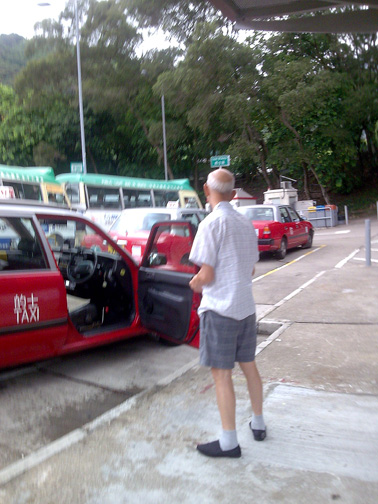
Waiting for another passenger.
May I help you?

For Reflections on Nursing Leadership (RNL), published by the Honor Society of Nursing, Sigma Theta Tau International.


23 November 2010

You only know it when you've gone through it

We learn about sandwich generations from books and by talking with friends and patients, but unless you have become one of those being “sandwiched,” you don’t really know what it means. Being sandwiched means not only that you have to look after your older and younger blood relations; it also means constant worrying about your parents and your younger ones, be they nephews, nieces or your own children.

At the moment, my mother is frequently on my mind. She has fallen four times since June. This is worrisome, indeed, but there is nothing much I can do. She lives with my brother in Toronto. My brother has been taking good care of her, but she is getting older and frailer each year.

I didn’t realize there is a comparative advantage of living in a smaller apartment. (Again, like I said earlier, learning has to be experiential.) When my mother visited me in Hong Kong just a few months back, she remarked that it was good that my apartment is small. She could quickly find something nearby to hold onto when she felt dizzy or when her knees gave way.

I didn’t think much about growing old when I was younger. I didn’t worry about saving money for the future when I was decades away from retirement age. In fact, retirement, secured old age, and so on, were not words and phrases found in my vocabulary when I was young.

There is a growing trend for people to say that we need to teach young people about growing old and getting prepared when they are still young; we need to plan for a secure old age decades ahead of time. As a gero nurse, I am not so sure about this. People grow into their own age. Learning has to be experiential. And where is the fun when, say at age 20, you have to be mindful of what you will become at 65?

Would continually thinking about old age take away our drive to move forward, to explore the world, to dream big dreams? Would teaching our young and making them think of old age prematurely rid them of the innocence of a full and “invincible” life ahead? What joy will it bring if we have to calculate risks when we are still young? We need to be responsible for our lives but not to that extent. At least not for me.

For Reflections on Nursing Leadership (RNL), published by the Honor Society of Nursing, Sigma Theta Tau International.

14 September 2010

About active ageing

My brother and I visited the Fujian Tulou (also called Earthen House) in southern Fujian Province, China, at the end of June. The tulou is an unusual type of Chinese rural dwelling. In 2008, UNESCO (United Nations Educational, Scientific and Cultural Organization) designated the Fujian Tulou as part of the cultural heritage of humankind. I had wanted to visit the place since I saw a commercial featuring a tulou a few years back.

There is an interesting story about the tulou. Reportedly, during the Reagan Administration, the CIA mistook them for nuclear devices and sent an undercover team, in the guise of a cultural tour, to check out the facts.

Tulou are mostly found in the southwestern part of rural Fujian. The area is hilly, full of terraced fields for growing tea and vegetables. Most of the people who live there seem to be engaged in farming or farm-related industries.

Well, this entry is not really about tulou, but about active ageing. One of the images that remains in my mind from my trip is seniors who were busy working in the fields or selling things on the road. They always had something to do. They didn’t seem to be worried or sad. They seemed contented and had a sense of purpose. It made me wonder whether city life has turned us into beings who are far too structured, where there is a time for everything, including retirement from work. There is no retirement in rural living. What better illustration could we have for active ageing than this?


For Reflections on Nursing Leadership (RNL), published by the Honor Society of Nursing, Sigma Theta Tau International.