10 July 2014

Learning to observe

I learn how to care for older people in practical ways by observing my mother. I notice how she can easily become tired—progressively so over the years. I see how she has become reliant on others for things she has been doing all her life without help—toileting hygiene, for instance. By watching her, I have come to see what her needs are. I also learn about caring for others by observing people in various circumstances. I take note if they are exhausted, annoyed, sad, or in pain.

As a teacher, how do I help my students value the power of observation, to notice the needs of others? Since we are in a helping profession, how do I teach development of observation skills to students who are engrossed in their own world most of the time?

How do we teach students to really "see" people?
I use public transport to go to work. In fact, I use public transport all the time. Because Hong Kong is such a compact city, I get around easily without a car. On trains and buses, people are engrossed with their smartphones, tablets, and what not, captivated with what these gadgets have to offer. Few people see an older man or woman board the train, much less offer him or her a seat. The same is true for those who are disabled, in the latter weeks of pregnancy, or carrying a baby. Few relinquish their seats, probably because most are busy playing video games, texting, watching movies, and so on. They attend to their own business, oblivious to the needs of those around them.

On those rare occasions when I do see someone offer his or her seat to another, I am sorry to say that, most of the time, the person who does so is middle-aged, not the age bracket of my students. What have we, as a society, done wrong? How do we teach our young—at home, school, in society at large—to care about others?

You will recall that I have made journaling an assignment for one of my courses. The exercise wasn’t as successful as I had hoped. Many students wrote “reflections” of what they had learned in a lecture—exactly what I asked them not to do. Despite including this assignment in my overall assessment of their performance, most students remained unobservant and unresponsive to what was happening around them with respect to elder care. Some did make excellent observations and reflections, but many did not.

My students are essentially good people. I know this when I hear them talk and get better acquainted with them as individuals. But I need to think of effective techniques to help my students “see” what is around them, not just “look” around and then go about their business.

I feel I am struggling against the current. Technological advances have changed our ways of relating to one another. As an educator, I love that technology helps me teach and engage my students in innovative ways. Yet, I am also watchful and wary of the impact that modern communications may have on how we interact with each other—whether we even “see” each other.

For Reflections on Nursing Leadership (RNL), published by the Honor Society of Nursing, Sigma Theta Tau International. Comments are moderated. Those that promote products or services will not be posted.

20 May 2014

Friends or family?

I respect and value my students as adults. I treat them as friends. At least, this is what I used to do, most of the time.

There are varying degrees of friendship. With some friends, you can talk openly; with others, you may not be able to spill your heart. But all of them are your friends—unique individuals who may or may not listen to you. We give adequate space to our friends, even very good friends.

As teachers, our students are hardly our best friends. With new batches of students passing through each semester or year, they are more like new acquaintances or new friends.

Having taught at my university for 17 years, I have come to learn that, sometimes, being a friend is not enough. Some students seem to respond better if you speak to them as if they were your adult children. I am not suggesting that we treat our students like young children, but I have observed that some of my colleagues do treat their students like their grown-up children, and, for some, this has worked.

We expect our friends to listen to us, to be good to us. Yet, we know that, no matter what we expect, a friend is not a family member. Family members make demands on us. Family members are connected to us on a deeper level. They are part of us, no matter what.

It is not so difficult to manage expectations of students who take a course or two from you. But what if you are their academic adviser? Being an academic adviser does not mean that the students we advise are close to us or willing to talk to us. So, do we simply provide academic advice about which courses to choose, how to study, and nothing more?

What about research students who work with us for a few years? Do we treat them like friends or family? When they repeatedly make the same mistakes, a friend would probably give up and say no more. But a family member would persist. Where do we, as teachers, draw the line?

When I was younger, my students were my friends. That was the way I wanted it. As I become older, I become less sure, and I realize it is unrealistic to expect from my students what I expect from my friends. Younger adult students are not yet that mature, and, if I were only a friend, I would be frustrated. I would demand that they be like me, that they think and work like me. But if I were to regard my students as my grown children who are trying to master particular subject matter, I would be more patient, more understanding, more tolerant of repeated mistakes.

I cannot say which is right or wrong, to coach my students as friends or as adult children. I only know that, with increasing age, my attributes as a teacher have changed. I hope I am now a more effective teacher. But that is for my students to say.

For Reflections on Nursing Leadership (RNL), published by the Honor Society of Nursing, Sigma Theta Tau International. Comments are moderated. Those that promote products or services will not be posted.

22 April 2014

Intended vs. actual outcomes: Puzzles of a teacher

In a previous post (13 March 2014), I mentioned that, to help my students become more observant of age-related issues, I ask them to write a journal. A natural follow-up question is, “So, how useful is that?” All I can say is, “I’m not sure.” Actual outcomes may be very different from intended outcomes.

When reading my students’ journals, I’m sure that some of them must have been written over a very short period of time, shortly before the due date for submitting them. I also read journals that are purely post-lecture reflections. That is, the entries are discussions of concepts I taught in class, which is not what I asked for. I wanted them to think about elder care outside of the classroom. Sometimes, I read journals that are superficial, mere recounting of what a student has read or heard in the news, but without personal reflection. Such entries are distant and somewhat “cold.”

sjenner/iStock/Thinkstock
So, how to teach elder care? How to ensure that students have learned something? These are intriguing issues.

Through group seminars (oral presentations and discussions), written papers, and tests, I know how my students have performed academically and what knowledge they have mastered. But I can never be sure whether I have prepared them to be better nurses in caring for older people.

Have I helped them develop the right attitude for interacting with older people? In the relatively few clinical practice hours required by the Nursing Council (the regulatory body for registered nurses in Hong Kong), have my students been able to translate what they have learned in the class into actual practice? Have they developed a deeper understanding about older people as unique beings? Do they care about older people who come under their care?

I have no answers to these deeper questions. By interacting with my students, I know for sure that some of them have developed such understanding and care. But, as a teacher, my goal is not to teach just a few; I have been given a class.

My students may have performed satisfactorily in their course requirements. Knowledge can be acquired, but attitudes develop over time.

For Reflections on Nursing Leadership (RNL), published by the Honor Society of Nursing, Sigma Theta Tau International. Comments are moderated. Those that promote products or services will not be posted.

02 April 2014

On teaching elder care, more reflections

More often than not, a college teacher is someone who is older than his or her students. That means there is already a “generation gap” and that the values and life goals of teachers and students are likely to be different. When there is a common goal, i.e., for the students to achieve certain learning outcomes in elder care, conflicts seem inevitable.

How should a teacher respond to the behavior of those who are younger and less experienced in life? More specifically, how should I respond to those whose values are vastly different from mine?


Xi Xin Xing/iStock/Thinkstock
I find myself becoming upset when students come late to class and don’t seem bothered by it. I become upset when I see them chatting in class, oblivious to the noise they are making. I get upset when they look at their iPads all the time and don’t look at the PowerPoint presentation on the classroom screen. Often, there is hardly any eye contact. And, certainly, I am upset when the student to whom I direct a question appears unaware of what is going on.

Sometimes, these classroom behaviors make me sad; other times, angry. The way I, as an older person, see it, they have nothing to do with a generation gap. Punctuality and attentiveness are classroom etiquettes expected of a learner in an educational context. To me, they are matters of common courtesy.

In the eyes of the younger generation, however, it seems that such behaviors are no longer expected and that I need to lower my expectations. To get students to accept and open up to me, I must accept what I find inappropriate. Sadly, according to my colleagues, not confronting students about their actions appears to be the new norm.

Nowadays, as a gero teacher, I need to repeatedly remind myself not to impose what I value upon my students. I know we grew up in different worlds and that our experiences shape us. I need to tell myself that being angry or sad will not help me win over my students and that I need to accept who they are before trying to change their behavior.

To know the origins of my frustrations and to stop being frustrated (because frustration will not help my teaching), I need to reflect on my own behavior, attitudes, and beliefs. In addition to knowing my self and my own limits, I must remind myself that, before I can teach the younger generation in a way that speaks to them, I need to understand and accept them.

For Reflections on Nursing Leadership (RNL), published by the Honor Society of Nursing, Sigma Theta Tau International. Comments are moderated. Those that promote products or services will not be posted.

13 March 2014

Teaching care of older people: Puzzles of a teacher

How does one teach a nursing student how to care for older people, when that student has very little experience interacting with older adults? When I ask my students if their grandparents are still living, many say they are not. Or, if they are, they don’t see them much.

So most of them are getting their notions about people of advanced years from popular culture—television, news, YouTube, etc.—or through their experiences with older people admitted into hospitals where the students are assigned for clinical learning. Younger people nowadays do not know older people the way people of my generation did, and they have limited opportunities to interact with them.

imtmphoto/iStock/thinkstock
If a deeper kind of learning is achieved only through experience, how do we help young people learn how to care for the old, when they don’t really “mingle” with them in their daily lives? How do I, as a teacher, help students appreciate the heterogeneity of seniors as individuals when students have perceptions, coming from popular culture, that more often than not are caricatures of certain behaviors seen in elderly people?

Of course, I try. I try to convince them that older people are not necessarily weak, needy, and cranky. I invite seniors to come to my classes and share their stories. My students are in awe of what they learn from these stories. They learn about people over age 80 who volunteer to help others in need. They never thought seniors could be like that. Another story—an individual close to age 90 who still hikes regularly and for long hours, a person who is much stronger than those much younger. My students listen in disbelief. Some even tell me they are inspired.

To foster intergenerational relationships, we need to begin with the basics—getting to know each other in our daily lives. A regular semester in Hong Kong is 14 weeks. How do we teach students who do not really know older people to develop the right kind of attitude and accumulate the knowledge they need in just three-and-a-half months? Is that “mission impossible” for teachers of gerontology?

I don’t think studying hard facts about age-related physiological changes in the aging body will help younger people better appreciate the needs of those who are growing old. Neither do I think that teaching students about common plights faced by older people—concepts such as cascade iatrogenesis, functional incontinence, and atypical presentation of illness—will make them better nurses in caring for the aged.

Well, I try. I try to cultivate awareness in my students of issues related to aging and older people by asking them to write journals throughout the semester. I ask them to write a brief note each week about news reports or incidents they have seen or heard about elderly people that intrigue or fascinate them. By asking students to actively look for such reports on a regular basis, I hope to sharpen their awareness about age and aging in the world around us.

Only when one starts to look will one begin to see. And only when we start “seeing” matters related to age and aging will we begin to ask questions. Questions lead to deeper reflections about ourselves and others. It is the first step that may lead to changes in us and, I hope, to changes in the environment that emanates from us.

For Reflections on Nursing Leadership (RNL), published by the Honor Society of Nursing, Sigma Theta Tau International. Comments are moderated. Those that promote products or services will not be posted.

14 October 2013

Good noises

Nobody likes noise, but there are some good kinds of noise, too. I notice it whenever kids are around, probably because I don’t have children. I don’t have to deal with their screaming and constant demands for attention 24/7. But as an objective observer, I think I know what I am saying—kids’ noise is good noise.

The aura in a room changes immediately when a child or two enters. They are so full of curiosity and energy. They are always on the move, playing with all sorts of things. They talk to you constantly and ask questions; they yell, and they scream. It is so much more fun when they are around. Their presence adds to the meaning of all that we do. I just love them.

Kids at camp house.
Kids playing Twister.
Little girls playing at Little Gobi in Mongolia
Yours Truly with Team 2 on Sports Day.

I fear for children if they are too quiet. I wonder whether their lives are miserable. Once, I was waiting in line with a young couple and their daughter. The 4- or 5-year-old was simply too quiet. I watch children whenever they are around, and I watched this child while I waited for the bus. She hardly moved at all. During the 20 minutes I waited for transportation, the girl changed her posture only slightly. She was standing too still, and talking with her parents too little. (I believe they were the parents). They, on the other hand, were talking nonstop. Finally, when she did move, walking a couple of steps toward their luggage to touch it and perhaps play with it, she was stopped by the two adults. It was only when they got onto the bus and the woman seemed to show that she cared about that little girl that my heart could rest. Otherwise, I would have carried on thinking of her.

Whenever kids are around, there are sounds of laughter. The world will lose its luster if, in our aging society, there are fewer children.

For Reflections on Nursing Leadership (RNL), published by the Honor Society of Nursing, Sigma Theta Tau International.

08 October 2013

Gender roles and ger building

From what I have observed, Mongolian culture has pretty much prescribed roles for men and women. Males show off their muscles, even when they are small. A few days ago, I saw some kids unloading firewood from a truck. As they did so, they jokingly showed off their “six-packs” and biceps. Their biceps were hard when they flexed and tightened their muscles. Of course, they don’t really have the six-packs, but they were still muscular enough. They are quite strong boys. I don’t think Hong Kong boys would be so muscular. Girls were not involved in this job.

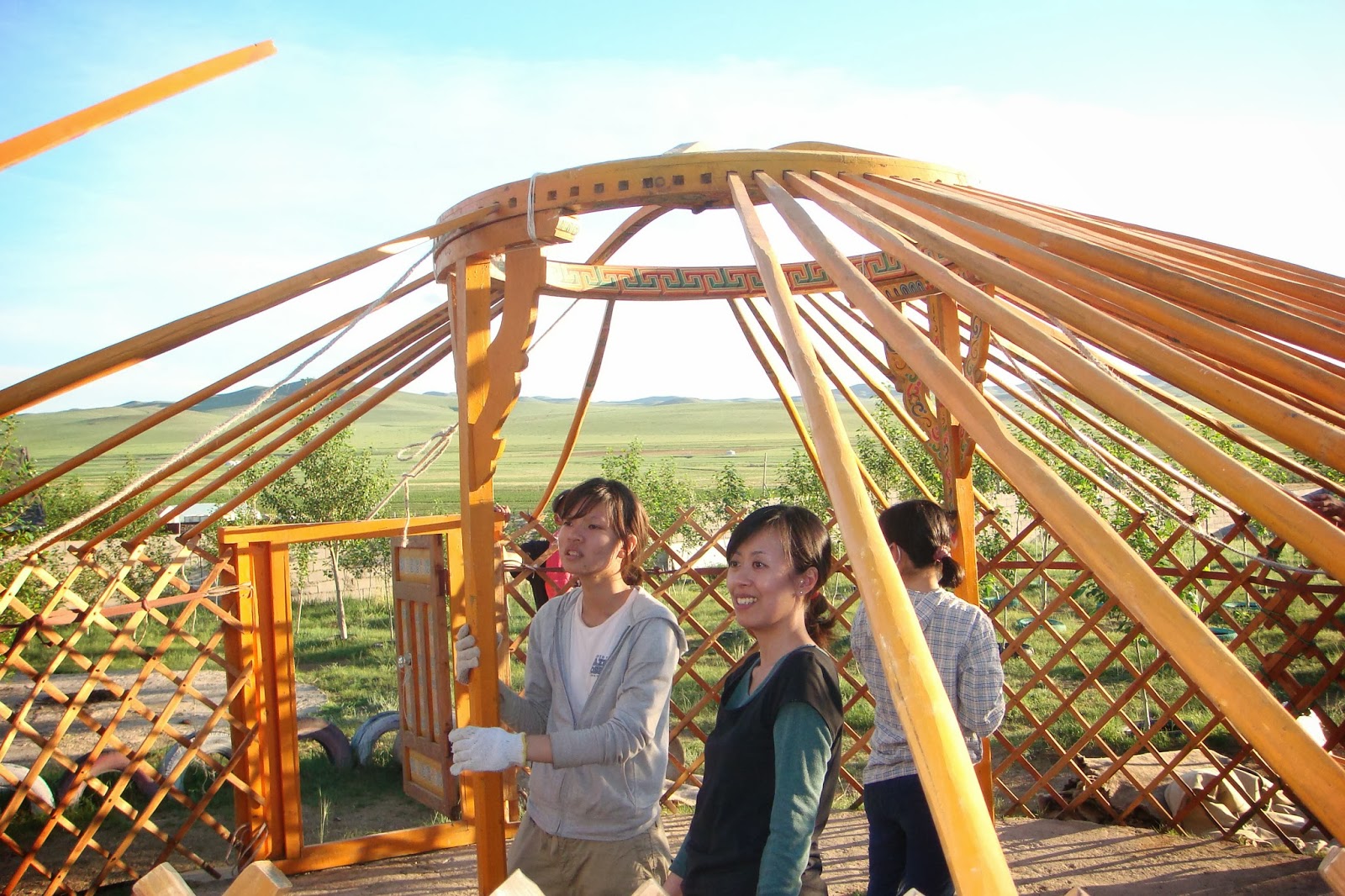
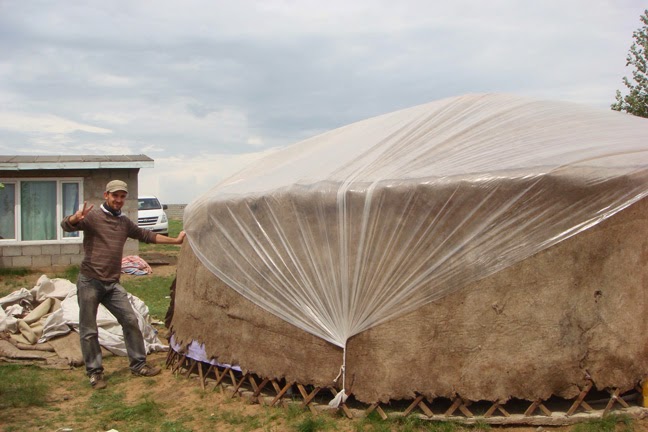
Sara, a staff member, informed me that Mongolian families do not have particular preferences for boys or girls; that boys and girls are treated as equal and females do a lot of the work that men do. I believe this, as Sara did a lot of hard work, too. But as I see it, jobs that require considerable physical strength are always performed by men (such as building a ger), whereas cleaning, mopping, and cooking are done by women. At any rate, this is what I have observed around the camp, in walking around the area and based on my limited interactions with neighbors in the work camp house.

The building of a ger:


For Reflections on Nursing Leadership (RNL), published by the Honor Society of Nursing, Sigma Theta Tau International.