08 October 2013

Gender roles and ger building

From what I have observed, Mongolian culture has pretty much prescribed roles for men and women. Males show off their muscles, even when they are small. A few days ago, I saw some kids unloading firewood from a truck. As they did so, they jokingly showed off their “six-packs” and biceps. Their biceps were hard when they flexed and tightened their muscles. Of course, they don’t really have the six-packs, but they were still muscular enough. They are quite strong boys. I don’t think Hong Kong boys would be so muscular. Girls were not involved in this job.

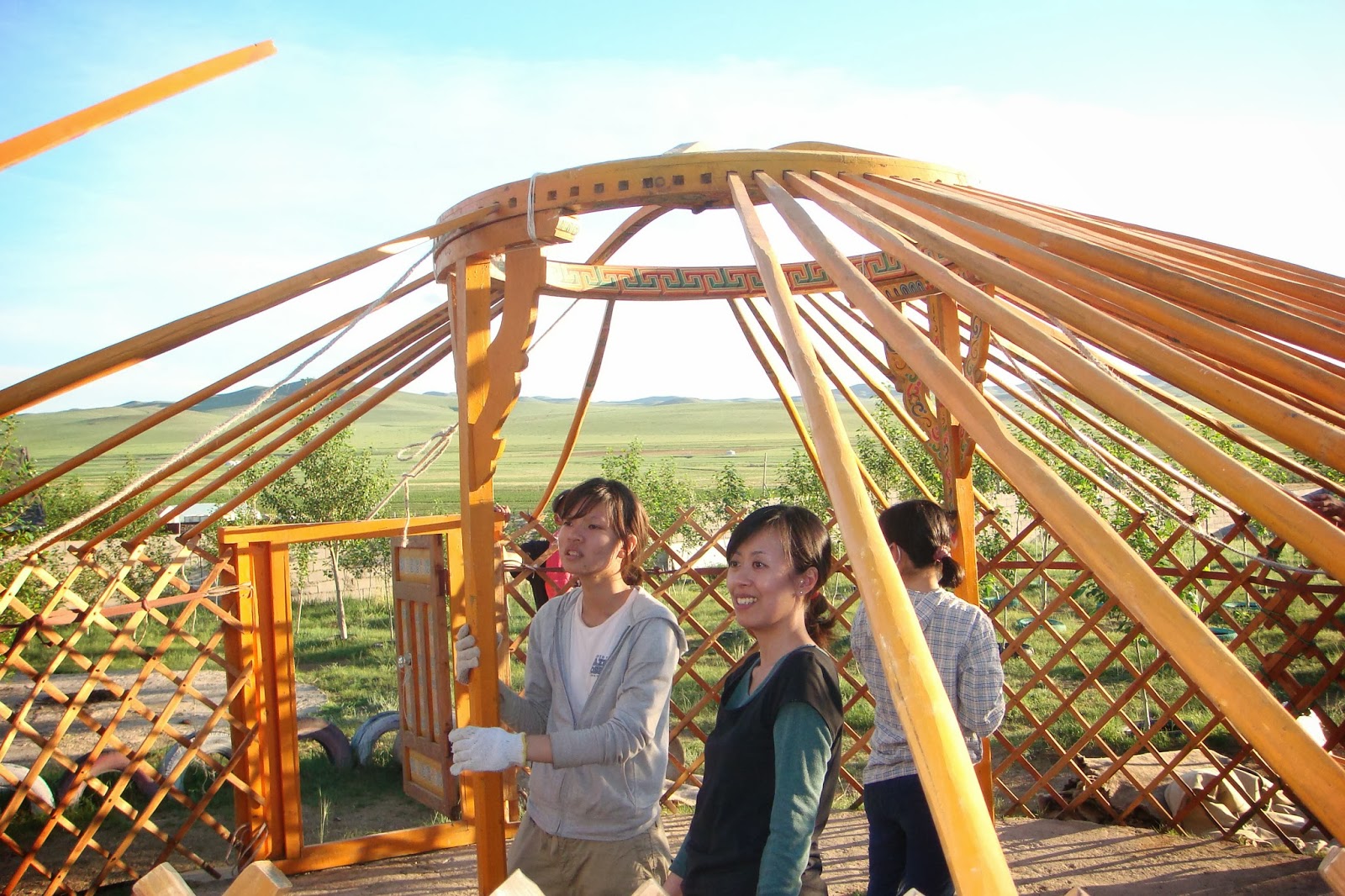
Sara, a staff member, informed me that Mongolian families do not have particular preferences for boys or girls; that boys and girls are treated as equal and females do a lot of the work that men do. I believe this, as Sara did a lot of hard work, too. But as I see it, jobs that require considerable physical strength are always performed by men (such as building a ger), whereas cleaning, mopping, and cooking are done by women. At any rate, this is what I have observed around the camp, in walking around the area and based on my limited interactions with neighbors in the work camp house.

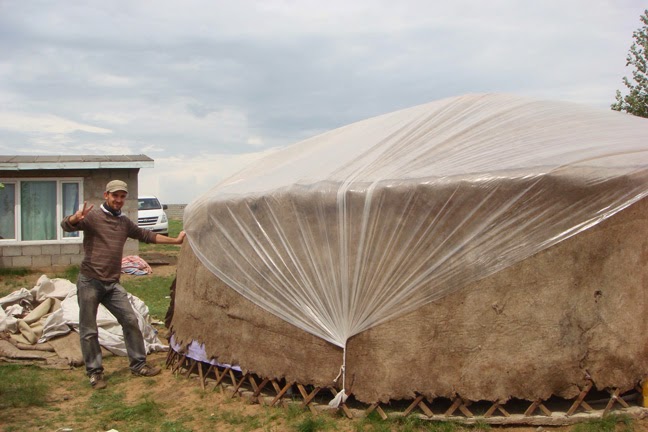
The building of a ger:


For Reflections on Nursing Leadership (RNL), published by the Honor Society of Nursing, Sigma Theta Tau International.

25 September 2013

The luxury of water


I look at my clothes after work, and, of course, they are dusty. But even when I looked at them before work, they still did not look clean. I think to myself that there will be lots of washing to do when I get home. I think of water gushing from the tap, the pleasantness of feeling clean from the inside out.

I miss running water. We don’t think much about it when we use it. We abuse it, let water run even when we are not, at that moment, using it, such as when we brush our teeth or put dishes into the draining rack after rinsing. We do it all without a second thought. What luxury!

In Mongolia, I miss running water.
There is no tap built into the camp house here in Mongolia. We have to bring water from outside to fill a large plastic bottle fitted with a plastic faucet, and it becomes a mini-water tank with a tap. We put a basin beneath the tap, to prevent water from spilling onto the floor and wasting it. We cook, we wash, and we use water minimally. At home, we may rinse our vegetables and our dishes several times, but here only once or, at most, twice; the same when we wash our clothes.

People come from afar to get water from a spring.
We tend to forget how lucky we are. Water is pretty much free. We pay only a nominal fee for the water supplied by the Hong Kong government. Some of us on this earth have sufficient water, and some do not. I hope I will remember this when I am back in Hong Kong.

How life has chosen us! It seems as if, for the most part, we have no say. I could have been a Mongolian girl or boy, born to a nomadic family, and not taken long showers whenever I felt like it. But I was born to a family in Hong Kong where, although life was hard for my parents, it hasn’t been so hard for me.

For Reflections on Nursing Leadership (RNL), published by the Honor Society of Nursing, Sigma Theta Tau International.

17 September 2013

Digging for meaning

Today was my first day working in the fields. This was my fifth day here, but I was cooking for two days and watering for one, and there was orientation the first day. So it was really only on the fifth day that I was truly working on the vegetable farm.

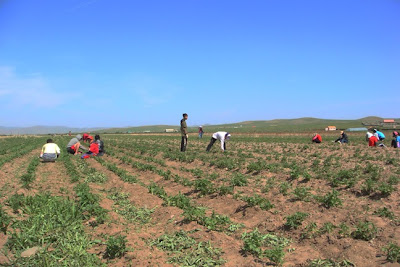
I was looking forward to it a lot. We were asked to weed the vegetables. We started walking out to the fields at 9 a.m. and probably started work at 9:15. As I took to my job, I dug out unwanted grasses. I don’t even know the name of the vegetable to which I was giving a helping hand. It didn’t look like a vegetable to me, but surely it must have been. It was somewhat recognizable because other members of the team had been working in the fields clearing weeds and unwanted plants.

The field was a rectangle, with lines and rows of small plants in between. So I went to the far end of the fields to start my work. Others had been assigned to a single row yesterday, and I had to start my own. Mostly I sat on the ground to dig, occasionally kneeling or squatting. It is a bit difficult to apply force when you are sitting on the ground.

Yours Truly, all covered up because of the Mongolian sun.
One of the fields.
Another field, this one potatoes.
Sitting out the battle of weeds, in the carrot field.
Before long, the kids came over to check me out. A moment later, one of them came to me with a spade and wanted to switch his tool with mine. He pretended to demonstrate to me how to use the tool, and then said, “Please,” but after trading tools, I realized that their spades were really not very good. But kids are kids, so I switched tools.


In the greenhouse, one of the kids, with a gardening tool.

There I was, repeating the weeding motions—shoveling the earth, digging at the roots of the weeds, pulling them out, clearing the vegetable of the weeds surrounding it, and putting back some soil to provide a small row of higher soil for the vegetables.

My actions did not require deep thoughts and, as time went by, I started asking myself, what does all this mean to me? I am not working effectively. I don’t have strong arms, and my efforts seem so slow. I am working hard, but it is really not such hard labor and could easily be done by someone else. I don’t think that what I am going to do here in four weeks is going to change the local peoples’ lives, benefit the orphans, or change anything, for that matter. So what is the purpose of my volunteering here?

I became a bit sad. Maybe I and the other volunteers are just here for our own benefit—to get a glimpse of Mongolian life.

When I first checked the time, it was already 11 a.m. I considered the slowness of my work. The amount of labor that I put in would probably contribute only a little of the produce. The other day, I asked Sara the price of spring onions. She told me that a bunch costs only 500 tugrik (Mongolian money). I am unable to see the fruit of my labors, and this makes me somewhat uneasy.

As a city dweller, an educated person, I need to see results. It is something that has been internalized by us city people. I need to find meaning in what I do. In our education, in our lives, we often ask or are asked for the meanings of our actions. We tend to think that having a sense of purpose enriches our lives. We teach ourselves and our young to be reflective. We aspire to be thoughtful individuals. But do we really need meaning in everything we do?
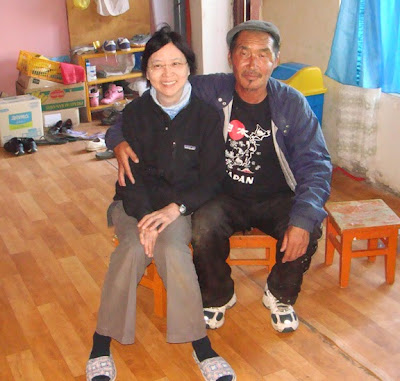
Yours Truly, with Senior Baatar.
While we were working, a man whom we called Senior Baatar walked by. (Baatar is a common name in Mongolia. There is Baatar, the head of the Mongolian Workcamp Exchange, and also another Baatar who looks after the farm in Bugus River, where the camp is, year round.) He was holding a small child on his shoulders, probably 2 or 3 years old. He said a few words to us, and then continued on his way somewhere with the baby. I thought to myself, does Baatar ask for meaning in his actions? Do we attach the same meaning to the word “meaning?” Does it really matter if we just live our lives without worrying too much about the meaning of things?

For Reflections on Nursing Leadership (RNL), published by the Honor Society of Nursing, Sigma Theta Tau International.

09 September 2013

Changing with the weather

Mongolians are very friendly people and more relaxed than others when it comes to time and schedules. While we—or at least I—who came from the city tried to work according to a schedule, the Mongolians seemed less concerned about it. We said we would have a welcome party at 9 p.m., but 9:10 came, and no one had arrived. The minutes went by, and it was 9:30 when we finally started the party.

At first, I thought Mongolians were less time-conscious because Mongolia is a developing country, but later realized that lack of development may not be the only reason they don’t pay as much attention to the clock. It could also be the unpredictability of Mongolia’s weather. In the morning, it may be sunny and hot, and then, in the afternoon, rain.

In the morning, it may be sunny and hot, and then ...
in the afternoon, rain.
One day, we visited the ancient capital of Mongolia. It was a fine morning, but dark clouds were looming in the distance.

Erdenezuu, the first Buddhist monastery in Mongolia,
was built in 1586 on the site of the country’s ancient,
13th-century capital.
By the time we finished our lunch and returned to the car to head back to our ger (traditional Mongolian tent), the weather was stormy, and our plan to ride horses and walk on the sand dunes of Little Gobi was postponed because of the wind and rain. (Tourists visit Little Gobi because of its sand dunes, which resemble those of Mongolia’s Gobi Desert.) It became quite cold in the night for the same reason. So, if the weather keeps changing, maybe we shouldn’t blame Mongolians' flexibility with regard to schedules on the culture.

As I spend time here in the camp and with some of the local people, I am starting to understand the meaning of Mongolian time. What is the hurry? And what is a schedule? In a world where nature speaks with a louder voice, what does it matter if we spend a few more minutes, a few more hours doing other things, improvising our plans as we go along? Maybe, because of the weather, there will be an opportunity for an unplanned visit from a friend or guest.

For Reflections on Nursing Leadership (RNL), published by the Honor Society of Nursing, Sigma Theta Tau International.

03 September 2013

Giving back in Mongolia

In the summer of 2012, I took a month away from my usual work responsibilities to join a volunteer work camp in Mongolia—a farming work camp for an orphanage. I thought I should do something different, so I chose something more physical than my normal routine. Some work camps seek health professionals, and others ask for teachers to teach English to kids. I wanted to have a break from nursing and health care, and I didn’t think I qualified as an English-language teacher. Each work camp lasts two weeks, so I signed up for two work camps.

At first, I thought I was going to Inner Mongolia, in China, and that I would be able to speak Putonghua with the kids. But no, it was Mongolia, the independent country. Well, so much the better.

Although I had been to Mongolia before, it was clear the moment I left the airport that I was in a different country than on my earlier visit. Nevertheless, it seemed to have retained much of its original form. There were no highways, and no trees were planted along the roadside. My first impression was that it is a very dusty country.

How do we measure the development of a city? I think we can do so by observing the number of potholes in the main roads and the number of puddles on the pavement.

My posts in coming weeks will be about Mongolia. Here are some photos.


In the background, the work camp's camp house. In the foreground,
the ger where volunteers stayed. A ger, also known as a yurt, is a
portable structure covered with felt, made from sheep wool.
The kids' dormitory.
Sitting on my bunk bed, the lower bunk.
Our four-star toilet.
For Reflections on Nursing Leadership (RNL), published by the Honor Society of Nursing, Sigma Theta Tau International.

19 August 2013

Hawkers

When I was small, there were lots of hawkers everywhere. They were on the sidewalk, outside shops and cinemas—anywhere you can think of—ordinary people like you and me, trying to make an honest living by selling stuff. Some sold food and snacks. Others sold small items like ropes, string, combs, hairpins, and so on. Anything you needed, you could find in some hawker’s basket. Yes, in the past, they mostly carried baskets.

Some of the hawkers were regulated; others were not. Those who were regulated had to obtain a license from the government. They occupied regular spots, where more defined spaces were available for them to show their products. Those without a license had to move here and there to avoid policemen and government workers of the Urban Council, which issued licenses for hawking.

As the city progresses, hawkers are disappearing. Fewer and fewer people are hawking—selling—things as a way to make a living. In previous posts, I have shown pictures of older people selling things on the street. They are occasional hawkers. Some have a particular spot where they sell their things each day. Others move about, choosing a spot as they see fit. They sell small things like safety pins, locks, buttons, shoelaces, and so on.

I don’t see many young people working as hawkers. For those who have been through hard times in life, it is never shameful to make a living by selling things of little significance. Young people prefer to work at McDonalds or KFC, which, to me, is no less important or significant than hawking on the streets. The two jobs serve the same purpose.

One virtue of aging is that we come to learn that “face” is not really so important. Having said that, I recall that there are some young people who are occasional hawkers. They sell CDs, fake handbags, counterfeit watches, etc. So I really shouldn’t pass a hasty judgment with regard to young people no longer hawking. It is only the nature of the goods sold that is different.

As a city develops, it becomes more and more regulated in all walks of life. Regrettably, when times are hard, it becomes more difficult to make an honest living out of selling stuff on the streets.

For Reflections on Nursing Leadership (RNL), published by the Honor Society of Nursing, Sigma Theta Tau International.

07 August 2013

What defines us?

“We are what we repeatedly do. Excellence, then, is not an act, but a habit.” That comes from Aristotle, or someone who translated a line by Aristotle.

What defines us?

Each day, as we go about our life, we do this and that. Rarely do we think of the unseen consequences of our actions. Of course, we know the outcomes of some of our actions and behaviors. We know, when we mark our students’ papers, they will get a grade. We know, when we go to staff meetings, our voices will be heard. But we rarely think of the results of our actions in the long term.

Are we who this man says we are?
We choose to meet a friend and have fun instead of working on a soon-to-be-due assignment. We go to a movie with our buddies rather than visiting an elderly aunt. We take a vacation and have fun, knowing we have stretched our purse strings. We choose to stay close to certain friends and not to others, regarding some as just acquaintances. It is hard to tell the meaning of all our actions, even though we make choices every day.

I sometimes encourage my students, using this proverb from Aristotle, so they know they can do well and excel if they keep trying. I would like to see them make hard work a habit. I believe in the normal curve. I know that the majority of people can do well because we possess more or less the same intelligence.

Do these behaviors and actions define who we are? Most of our actions are innocent, but in the end, probably everything we do defines who we are.

We like to spend our money in certain ways. We like to use our time in some fixed manner. We act and react toward others in ways that reflect our personalities (who we are over time).

I wonder if, in old age, we feel remorse over our behaviors and actions. Do we ever wonder why we are who we are?

For Reflections on Nursing Leadership (RNL), published by the Honor Society of Nursing, Sigma Theta Tau International.