22 June 2012

Loud

The world is a loud place; loud not just in terms of auditory sensations, but also in visual and other forms of stimulation, including tactile. However, visual and auditory assaults are probably the more common types we have to face day in and day out.

One day, I walked past a Catholic high school and, suddenly, an image caught my eye. A display board above the entrance to the school was rolling out colorful, electronic messages announcing that evening courses were now open for enrollment.

I was fascinated. Was it really necessary to be displaying such messages? Would they be useful in attracting students? If even a Catholic school, which I assumed would be more subtle in its actions, would do something like that, what could one expect of secular institutions?

Nowadays, it seems that, to be heard, we have to make loud statements We protest, prepare elaborate publicity strategies, create stunts and make dramatic moves for fear that, if we don’t, we will be ignored. Do we have to be loud to be heard? Does nobody care unless we are loud?

Everything and everyone is competing for attention. We are drowning in all kinds of sensory messages. But are all of the incoming messages useful or meaningful to us as we live our lives?

For Reflections on Nursing Leadership (RNL), published by the Honor Society of Nursing, Sigma Theta Tau International.

14 June 2012

City landscapes

My city is a fascinating place. Pardon me for saying so, although I believe everyone must feel more or less the same toward their own town or city. Beneath the glamour of the central district in Hong Kong, the city is very Chinese at heart.

Shatin, the town where I live, has a population of 600,000 to 700,000. A huge town by any standard, it is one of the earliest developed satellite towns in Hong Kong. Despite its development, it is rather rural at heart in many aspects. 


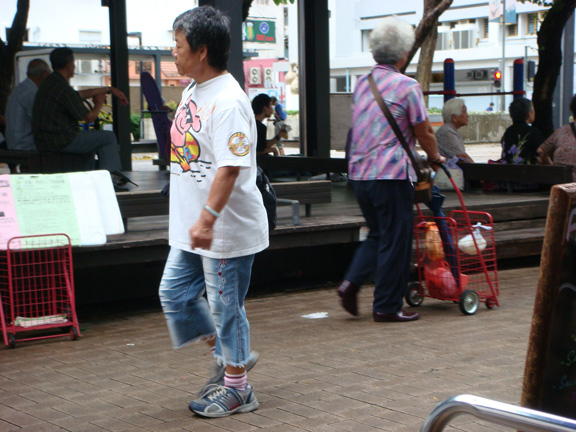
We have a wet market in the town centre. Every day, you can see lots of older men and women sitting in the small gathering places outside the wet market to socialize. They like to go into banks to speak with the teller in person, rather than using machines. You see them wearing traditional outfits. (I am not referring to traditional Chinese clothing, but the way traditional older men or women normally dress— in an old-fashioned way.)

Corner of a wet market
Sights in Shatin are not the same as those seen by tourists in downtown Hong Kong. Shatin is more rural, its landscape more diverse. It is not quite the concrete jungle that Hong Kong is famous for. And, of course, there are other satellite towns that are similar to Shatin. That is why, to see the real Hong Kong, visitors should explore the suburbs.

The city landscape is as diverse as it can be. In the photos below is a “spider man,” a construction worker on bamboo scaffolding. This is how some construction is done in Hong Kong, using bamboo to build scaffolding, not steely cages made of nuts and bolts and iron rods.

A spider man

I hope you enjoy these glimpses of my city’s landscape, mostly with our eyes on Hong Kong’s seniors, of course.

For Reflections on Nursing Leadership (RNL), published by the Honor Society of Nursing, Sigma Theta Tau International.

28 May 2012

Urban planning

It is projected that, about 25 years from now, one in four people in Hong Kong will be age 65 or over. Amazing! Have you ever imagined what it will be like when you walk on the streets or go anywhere in the city where you live, and every fourth person you run into is a senior? I have been thinking about that lately.

I think there will be more wheelchairs everywhere. Walkways, pavements, passages, etc., will need to be provided to cater to this need. They will have to be much wider. I visualize that elevators and escalators will be much slower than they are now, to allow for the slower reactions of older people. I imagine that public transport will have more special features that cater to the needs of people who require walking assistance, and for wheelchair users. And it will only be reasonable to have more resting places throughout buildings and public places, where people can pause and take a break.

Navigating stairways is a struggle for many seniors.
Activists are pushing hard for industries and the commercial sector to adopt the principles of universal design so that we can begin creating a more friendly environment for the old and disabled. By then, I don’t think we will need to fight that hard. Universal design will be incorporated in lots of places, maybe nearly everywhere. The sheer political force of the large number of seniors will make their voices more easily heard and their demands better answered.

For Reflections on Nursing Leadership (RNL), published by the Honor Society of Nursing, Sigma Theta Tau International.

10 May 2012

How to choose?

You and I have 24 hours a day. Each of us gets the same—no more and no less. I can spend portions of my time grading assignments and writing manuscripts, or I can go and join my extended family for lunch or dinner. I can use the time to write up reports and prepare abstracts for conferences, or I can have a tea party with two colleagues celebrating their birthdays or go to movies. So what do I do? And how do I choose?

If I choose to relax and enjoy my time with friends and family, I come home feeling guilty that I am behind at work—that I haven’t tried my best to perform, to do my best in whatever I have been trying to achieve in my professional career. If I choose to keep working during the evenings and weekends, yes, there is a sense of accomplishment, that something has been done, completed. Yet, I yearn for connection with family and reprimand myself for not looking after me. My mind and body deserve to be treated with respect. My eyes, my wrists and my back cry out for time away from the computer screen. I also feel guilty that I am not living life as it should be, but instead making work my whole life. I am in a Catch-22 situation. Are you?

Modern men and women who live in cities lead very busy lives. We go about our business as if we are the centre of things that are about to happen. Our behavior suggests that the world cannot turn without us. Of course, we know it isn’t true. But we multitask like crazy, nonetheless.

This struggle to spend our time wisely—when will we find a way to resolve the dilemmas presented to us? Will we always feel this way until we retire? And what will life in retirement be like?

For Reflections on Nursing Leadership (RNL), published by the Honor Society of Nursing, Sigma Theta Tau International.

20 April 2012

Fashion versus beauty

When I go to work, I always pass through a mall, because the train station is at the end of the mall. Each morning, I notice that the shop windows show different clothing. As the seasons change, so do the styles of clothing on display—whatever is trendy at the moment.

Sometimes I smile as I walk past, because I know that some of the very stylish items I have seen in the windows before, decades ago—the necklines, the hemlines, the waistlines—they just move up and down, left and right. I have come to realize that, if one lives long enough, one will see that there is nothing new under the sun. Things may reappear somewhat differently but, by and large, they are not new things.

There was a time when I subscribed to National Geographic. I still vividly remember one particular feature. A photographer, writing about the wild animals he had shot, asked what could possibly be more beautiful than the natural look of these wild animals. One picture I remember was that of a big elephant. The photographer called it beautiful. I like elephants, but I have never considered “beautiful” as the word to describe them. His remark gave a new definition to “beauty” in my personal dictionary.

Yes, the elephant was more beautiful than the somewhat expensive clothing one may acquire over the years—dresses, handbags, shoes and all sorts of accessories. And such beauty is always there; it does not go out of fashion.

For Reflections on Nursing Leadership (RNL), published by the Honor Society of Nursing, Sigma Theta Tau International.

03 April 2012

Communal culture

I was early for my Geopark* trip with my friends. So there I was, sitting in a bakery and coffee shop in Sai Kung that opens early. Knowing I would be early, because I didn’t want to miss this hiking and boat trip that I had been so looking forward to, I had brought a book with me to read, but I never got a chance to read it.

The bakery is right outside a public pavilion where people gather for various reasons, or no particular reason at all. I was fascinated by the people traffic. I couldn’t take my eyes off the place. I saw older men and women, some with Filipino maids, using this public space as their social meeting place. Whereas young people use online social media, seniors use these physical spaces to stay connected.

I recalled the pictures I have taken of seniors gathering in public places. Then, suddenly, it dawned on me: This could be one of the major differences between aging in the East as opposed to the West.


Where in American and European cities would you find scenes such as those shown in these pictures? I would say that these are cultural manifestations of aging, differences between a collective-oriented culture versus an individualistic culture.

*The Geoparks initiative was launched by UNESCO to recognize and preserve sites of significant earth science interest.

For Reflections on Nursing Leadership (RNL), published by the Honor Society of Nursing, Sigma Theta Tau International.

19 March 2012

Ageless attire

Do you know of any attire that is truly ageless, or age-neutral?

You’re right. Jeans. There is another one. … That would be the backpack.

I love jeans and backpacks. These items are a regular part of my outfit. They are suitable for kids, teens, adults and seniors—not exclusive to any particular age group. Of course, the occasion is important. You can’t wear jeans to a black tie event.


They are gender-neutral, good for people of all shapes and sizes. Jeans have been marketed as a sexy commodity. Sexy or not, they are practical, and you don’t need to think or feel that you are sexy in order to put on a pair.

They are just great inventions. I wish there were more goods, ideas—whatever—that would transcend the age boundary. I hope that, in the world we live in, a time will come when age really doesn’t matter that much. That would be a world radically different from the one we know now.

For Reflections on Nursing Leadership (RNL), published by the Honor Society of Nursing, Sigma Theta Tau International.